
Santa Rosa Janitorial
Commercial Floor Care in Santa Rosa
Commercial floor care in Santa Rosa removes everyday dirt and treats deeper soil or worn finishes with methods suited to the installed material.
Daily dirt and carpet traffic lanes
Vacuuming removes loose soil from carpeting, while routine hard floor cleaning addresses dirt on the surface. Carpet extraction and spot treatment provide deeper care for affected areas beyond the daily routine.
Distinct treatments for floor finishes
Scrubbing lifts ground-in dirt from VCT, tile and sealed concrete. Burnishing brings the shine back to a finished floor, recoating adds fresh finish where traffic has worn it thin, and strip and wax replaces a finish that is past saving. Polishing brings marble and terrazzo back to an even shine.
Natural stone and return to use
Natural stone is cleaned with products and pads suited to the stone and its current condition. Each periodic treatment needs time to dry or cure, so the room reopens once the finish is ready.
Choosing the right treatment
Every floor in a building ages differently. Tile in a breakroom, carpet in a reception area, and stone at an entrance each respond to their own methods, so the installed material and its current condition decide whether scrubbing, recoating, burnishing, or a full strip and wax is the right next step.
Planning matters too, because periodic treatments need time to dry or cure. Booking the work for an evening or weekend keeps rooms out of use only as long as the process requires. Carpeted rooms go to commercial carpet cleaning, and every floor treatment is available across our Sonoma County service area.
Hard floor treatments, one by one
Scrubbing is the workhorse: it lifts embedded dirt from tile, finished floors, and sealed concrete without removing the finish. Burnishing follows on finished floors, bringing back gloss between deeper treatments. Recoating lays a fresh layer of finish over a worn one, which extends the life of the existing coat and delays the need for a full reset.
Strip and wax is that reset. The old finish comes off entirely and new coats go down, which is why it takes the longest and needs the most time before traffic returns. Polishing is its own treatment, covered below.
Marble, terrazzo and bare concrete
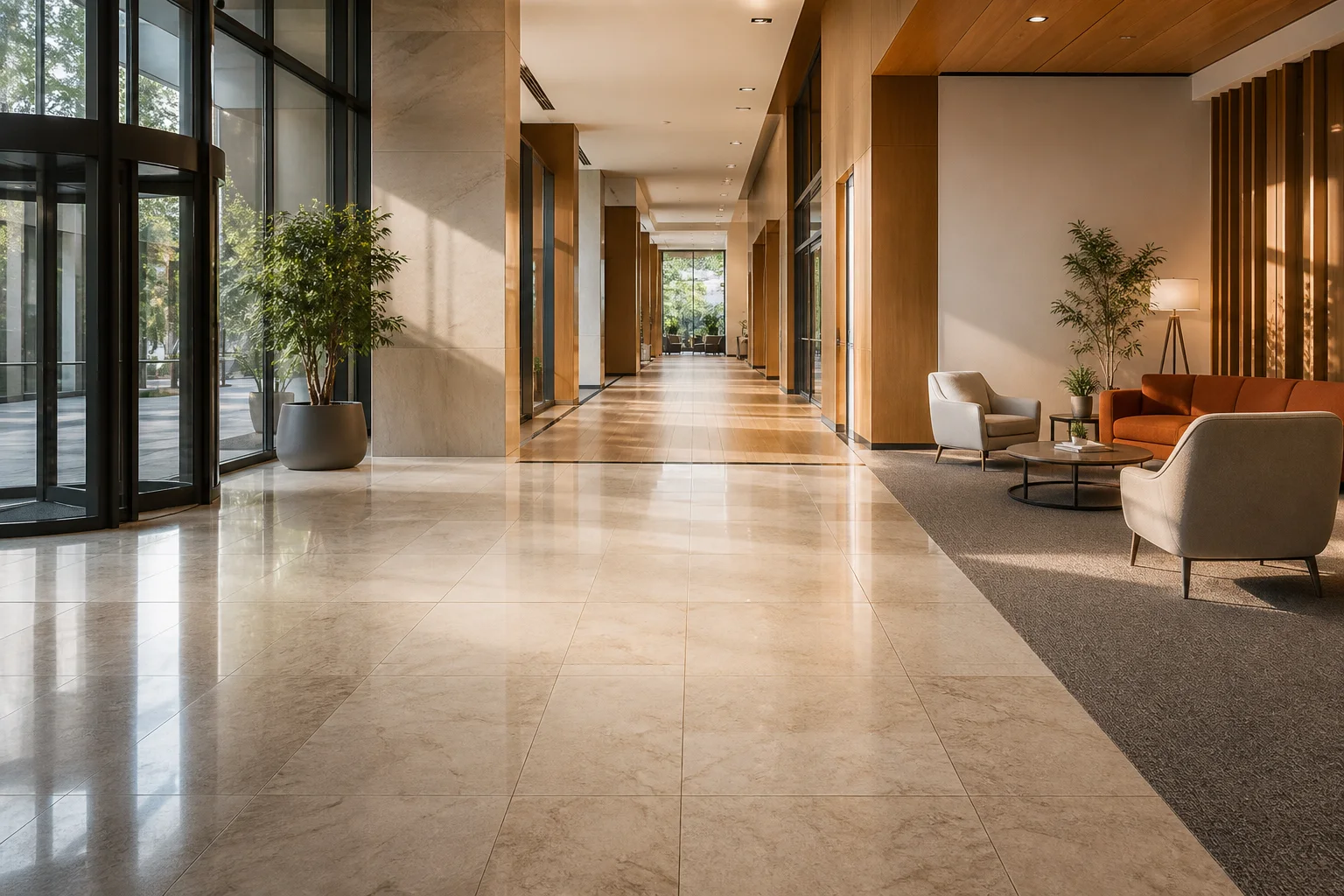
Marble and terrazzo entries get a cleaner made for stone, then a polish that brings back an even shine across the whole lobby. Booked on a regular cycle, that care keeps grit from dulling the surface between visits.
Bare concrete in warehouses, back corridors and loading areas is machine-scrubbed to lift ground-in grit and spills, priced from the size, condition and access of each floor. Vinyl composition tile in breakrooms and halls gets a full strip and refinish once the old wax has worn through.
Planning a floor care calendar
Most commercial floors follow a pattern: routine cleaning on every visit, scrubbing and burnishing on a regular cycle, recoating when the finish thins in the traffic lanes, and a full strip and wax only once the finish is beyond recoating. Planning the cycle ahead spreads the work out and avoids a single long shutdown of a busy room.
Entrances and breakrooms reach each stage first. Treating them on their own schedule keeps the rest of the floor from being stripped before it needs it, and keeps the most visible floors looking their best.
Floors in Santa Rosa commercial buildings
Santa Rosa’s mix of professional offices, medical offices, retail and hospitality interiors means many buildings carry several floor types at once. A medical office often pairs carpeted waiting rooms with hard-surface treatment rooms, and a storefront often runs tile at the entrance with a finished floor across the sales area.
Floor care sits alongside recurring janitorial visits, which handle the routine vacuuming and mopping, and post-construction cleaning, which clears dust and residue from new floors before their first periodic treatment.
What strip and wax costs for Santa Rosa floors
Stripping and waxing is priced per square foot, with a minimum charge for each visit. In Santa Rosa the usual band is $0.46 to $1.00 a square foot as of 2026; large, open floors in good condition start near $0.36, and small, heavily built-up or detailed jobs reach $3.00, according to 2026 regional market pricing.
Picture a medical office with 2,600 square feet of VCT across its corridor and waiting room. Stripping the old finish and laying fresh coats at $0.62 a square foot comes to $1,612 per job, or $3,224 a year if it is done twice. Recoating and burnishing between strips cost less than a full strip, and they stretch the time before the next one.
The condition of the existing finish drives most of the price. Several yellowed layers take more passes to remove than one worn coat, and furniture to move, small rooms and tight corridors slow the machines, which is why small jobs carry a minimum charge. Natural stone care, polishing and concrete scrubbing are separate methods with their own pricing. Each treatment needs its drying or curing time, so a weekend or overnight visit that keeps your business open adds to the cost. We look at the floors during the walkthrough that begins every quote and price each treatment from what we see.
A few useful answers
Frequently asked questions
Does hard floor care include stripping and waxing?
Yes. We strip and refinish VCT and other finished resilient floors.
How does carpet extraction differ from vacuuming?
Extraction treats soil held deeper in the carpet, while vacuuming removes loose dirt.
Is natural stone flooring cared for?
Yes. Stone entries and foyers are cleaned with products and pads made for stone, and periodic care keeps the surface even.
How long does a stripped and waxed floor stay closed?
Timing follows the finish and the room conditions, which is why strip and wax is booked for evenings or weekends when the room can stay closed until the finish cures.
Is burnishing the same as polishing?
No. Burnishing is a high-speed buff that restores gloss to floor finish on VCT; polishing refines marble and terrazzo themselves.
Can floor care be scheduled alongside the regular cleaning visit?
Yes. Periodic treatments are booked alongside recurring visits, often on a weekend, so the floor work has its own time slot.
Industries
Related industries
Resources